Monday, July 22, 2013

Daily Five - Work on Writing

Work on Writing is the next piece of Daily Five I plan to implement.  "The Sisters" - Gail Boushey and Joan Mosher, in their more recent writings recommend adding this element next after Read to Self.  This is a change from the order presented in the book, The Daily Five.

This change emphasizes the utmost importance of BOTH reading and writing. This makes sense to me as they are so closely related.


Be sure to read the book for more complete details about Work on Writing.  It is an amazing resource.  


Quote from page 80 of the book, "Intensive work (and play) in writing and word study also supports reading development.  The two components of Daily Five, Work on Writing and Word Work, help students hone their skills as writers and their knowledge of words."

How does Work on Writing for D5 differ from Writer's Workshop?  The main difference between the two is that during Writer's Workshop, I choose what the students are writing about such as a grade level genre piece or a specific writing strategy.  During D5 the kiddos may choose to continue working on their pieces started during Writer's Workshop however during the D5 it is their choice of what to write. That choice is the key.

Work on Writing follows the same gradual release model of instruction that will be repeated as you introduce each of the components of Daily 5 - Introduce, Brainstorm I-Chart, Model, Practice, Repeat, Build Stamina.  Refer to Chapter 6 of the book for excellent descriptions of what this looks like in a classroom.

I want to focus on what those very first lessons will look like in my classroom.  How can I foster the independence necessary to make D5 a success in first grade?

Day 1 - Create I-Chart of expected behaviors
             Teacher model writing process
                   Tell a short story.
                   Model the writing on chart paper (Write 3 or 4
                   sentences.)
                   Model underlining words you don't know how to
                   spell.  Come back later for spelling.

Day 2 - Brainstorm - Practice where to sit and what materials to use.   (Notebook/journal, pencil or pen, drawing or sketching - I plan to put their notebook/journal and a pen or pencil in their book bins.)

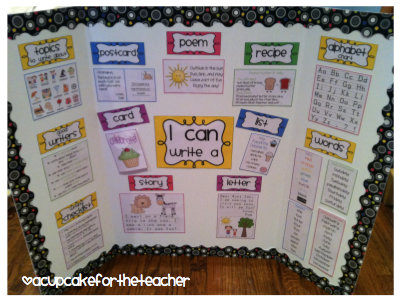
Day 3 - What can we write about? Make a list of topics, a list of forms, and post the lists for the students to use when they are writing.

I plan to use the forms from this great resource from A Cupcake for the Teacher to make a writing bulletin board in our writing center.  I found her Writing Center Starter Kit on Tpt.  It has everything I will need to get started. Check it out.


Day 4 - Continue to teach different forms of writing in short focus lessons.  Begin practice sessions for 3 minutes.  Practice 1 -3 times as time allows.


Continue to follow the model of placing the kiddos around the room with their book bins, practice, signal, return to gathering place, check-in, revisit I-chart,  then practice again.  Add 1 minute each day until you build stamina to 20-30 minutes.
This bright carpet will be perfect for our gathering place.  I  can't wait to get into my new classroom and start setting it all up for first graders.

I know one of my biggest challenges will be to move away to the guided reading table and not use eye contact or proximity to manage the kids behavior in order to foster independence. Challenging but necessary.

How do you do Work on Writing with your class?  What challenges have you faced?  I would love to hear about your insights, suggestions, or successes.

~ Clara @ Teaching 365
First Grade Sunflowers and Ladybugs


Wednesday, July 17, 2013

2nd Grade Stuff: What Do the Kids DO During Daily 5?

Jaime at 2nd grade stuff has written a great post on how Daily Five works in her classroom. She answered many of the "how do you..."  questions I had. Below is a link to her post.


2nd Grade Stuff: What Do the Kids DO During Daily 5?: One of my most visited blog posts is a post entitled " The Centers That Have Saved My Classroom! ".  I originally wrote that blog...

Sunday, July 14, 2013

Daily Five - Read to Self

Read to self may be the most important literacy learning in first grade.  In the past, my read to self time was DEAR, SSR, silent reading... a time when the kids chose a book, read it, and took an AR (Accelerated Reader) quiz to show they understood it.  This is quite different from the Read to Self described by "The Sisters" in The Daily Five.

I need to spend focused teaching time with the key concepts, materials,and routines to launch Read to Self with both mini-lessons and materials the kids will need.  

One of my big jobs to prepare for this part of Daily Five will be to organize book boxes for each of my students (25 first graders).

The kids will need an individual book box for their books.  It will have 3-8 picture books, magazines, and easy chapter books that I have selected for them to read. 

Here is a pic of the bins I will use.  Now I just need to label them and fill them.


I will post more pictures after I have it set up in my classroom. 


Mini-Lesson: 3 Ways to Read a Book
This lesson honors the kids level of reading development, whatever it may be.  In Daily Five, this lesson addresses the kids' belief that reading only means reading the words. 

What are the 3 ways?
Read the pictures
Read the words
Retell a familiar story

Mini Lesson: Good-fit Books
Using an anchor chart "I Pick" gives 5 ways to help choose a "good fit" book. Some time after this lesson, kids will choose their own books for their book boxes. For kids to grow as readers, they need to spend lots and lots of time reading with the majority of that time with "Good-fit" books.


 Daily Five - Model, practice, model, practice, model, practice,then repeat.

I will definitely need to go slow now to go fast later.  There is so much more in the Read to Self portion of the book.  Once again, get the book and read it, and then read it again. I am certain to keep it nearby as I continue my journey with Daily Five in my first grade class.


How have you used The Daily Five and Read to Self in your classroom?  Challenges, successes?  I would love to hear your thoughts.

~Clara


Monday, July 8, 2013

Daily Five - Reading the book The Daily Five - Part 1

It only seems natural that if you plan to try someone's ideas in your classroom, that first you should read the book.  "The Sisters", Gail Boushey and Joan Moser wrote a book detailing each part of this literacy process.  My first question to myself was, "What is Daily Five?"  I had been reading all over the web, Facebook, and Pinterest about it - Step one - Read the book!

Click here to view more details about the book. The Daily Five


"The Sisters" also have a website with extensive resources to support Daily Five along the journey.  I am considering buying a subscription to access all the wonderful videos and resources but many of them are free and accessible without a membership. 

The official Daily Five website

"The Daily Five is a series of literacy tasks which students complete daily while the teacher meets with small groups or confers with individuals. This book not only explains the philosophy behind the structure, but shows you how to carefully and systematically train your students to participate in each of the components." Quote from The 2 Sisters website. 

I would love to hear from you about your Daily Five journey. Right now I have more questions than answers. 

My next post will be about the first of the Daily Five routines, Read to Self. Those first days of school in first every grade are especially important to establishing routines.

~Clara 


Saturday, July 6, 2013

Classroom Freebies: 100+ Behavior Reward Ideas

Each year I struggle with classroom rewards.  It seems I always return to the tickets and treasure box.  Check out this awesome post about using intrinsic and non-gift rewards for student recognition.  I need to try it.  How do you recognize great behavior in your classroom?  I would appreciate your input.


Classroom Freebies: 100+ Behavior Reward Ideas: Tired of the treasure box? Need a list of intrinsic or non-gift type rewards for great student behavior to use as incentives? Yo...